At Hack Your Way, a marketing conference from the team behind Marketing Festival in Brno, CDN77’s CMO showed how the company hacks its marketing. An editor of Marketing & Media, the Czech weekly on marketing and advertising, asked the CMO for an interview, and she referred him to me, since much of the work she had shown was mine. In the interview, I explained how a three-person team takes on far larger American rivals: by knowing customers’ pain points, showing up where the audience is, and making B2B ads people talk about.

Issue 21/2025, May 26, 2025. The online version is behind a paywall, so the original Czech pages are shown above, with the full English translation below.
“We replace a big budget with brains and creativity.”
“Humor is universal. It connects people and leaves a positive emotion.”
“When people recognized which company I was from, they came to praise our ads.”
We need to focus on our customers’ pain points, says Hana Tran Phuong Tra of the globally successful Czech company CDN77.

Among CDN (Content Delivery Network) providers, they rank among the global top five. Only four American giants are ahead of them. Yet very little is known or said about this Czech company, headquartered across four villas in Vinohrady. “I’m a little sad about that, and it’s something we want to work on. We often hear from people they had no idea how big we really are,” says the marketing manager of a company with over four billion crowns in revenue.
Since we operate in small teams and there are basically only three of us in marketing, we allocate most of our capacity to building the brand within B2B. Moreover, we focus on the global market. Only one percent of our revenue comes from the Czech Republic, and there is no major globally operating content company located here. Visibility matters mainly for recruitment, but even that is not a current priority, although we do need to hire.
We focus primarily on video content, which accounts for the largest share of data on the internet. Take Netflix as an example. It may have its origin servers in the United States, but for a user in the Czech Republic to stream a movie smoothly, the data would otherwise have to travel that entire physical distance. That would result in slow loading and buffering. Instead, the content gets cached on the nearest edge server within the global network, which then delivers it directly to the viewer. This makes playback faster and smoother.
Exactly, and not only here. We deliver eight of the fifty biggest websites worldwide. Our service is only truly perfect when it stays invisible. The moment people start noticing it, that means something is broken.
These include online media such as streaming services, social networks with heavy content, gaming companies, and music platforms. Essentially, anywhere there is a large volume of data.
Our growth has been driven by a strict focus on three things: the customer, efficiency, and long-term financial self-sufficiency. From the start, our CEO recognized that customer focus was a major differentiator, especially since many competitors neglected it. In marketing, we avoid unnecessary spending and push for out-of-the-box thinking. I mean, what does an expensive conference booth handing out bubble tea really do for brand relevance? Or why sponsor Formula 1? Is the target audience really there?
When a customer needs something, we don’t look at the Q4 roadmap. We simply build it for them. Quickly and without the corporate approval cycles. If someone reports an issue, they get a reply within minutes. Larger clients get direct access to real engineers. We make a genuine effort to understand each customer, learn their needs, and help whenever required. Many of them value our proactive communication and support.
It’s not difficult with existing customers, because our salespeople are in constant contact with them. Thanks to the fact that we share an office, us marketers know their needs as well and how to communicate with them. Potential customers are trickier. But these are still similar types of companies, so if you know the needs of existing clients, you have an idea of what potential ones need. What can be more difficult is finding the relevant contact. Who in the company decides about CDN, what interests them and what worries them.
Absolutely. This was evident when three CDN providers went bankrupt in recent years. As soon as that happened, we immediately went to the market and offered to their clients that we would take care of a smooth and timely transition. The competition didn’t really address this.
Yes. Our advantage was fast reaction. As soon as the bankruptcies were announced, we met with sales to plan. How to announce it on social media, who to contact, and we reached out directly to affected companies. Facing extremely tight deadlines, clients appreciated that we took the time to ensure a smooth transition. Often, customers end up paying both the old and new CDN providers during the switch. We wanted them to avoid this by letting them move to our service without paying us during the transition, which usually takes several months.
As I mentioned before, we have to prioritize and assess what really makes sense. We don’t rely on a big budget like our competitors, we replace it with brains and creativity. We are constantly thinking about how to be where our target group is, and ideally not pay too much for it. I focus on conferences that all the leaders we are interested in attend. My colleague is dedicated to online, where it’s harder to hit the target group, but still necessary. As a marketer, I like to do nice things, but sometimes I just have to tell myself that I don’t have the capacity for it.
Quite a lot. I follow a lot of brands and I haven’t seen many creative campaigns. But I enjoy being creative, so I thought it has to work. But how do you materialize a product into an ad (servers, cables, speeding up internet) and do it in a funny way? That’s what we spend a lot of time on.
Marketing outputs must evoke emotions, they must leave something in people. Humor is universal, it connects people and leaves positive emotions. That’s why I try to play with it.
It may but doesn’t have to. We’re in a business where there’s a lot of money and important infrastructure involved. But even if you’re selling to businesses, you’re still selling to people, and humor usually works with people when they’re smart. This is especially true in B2B, where the target audience is much smarter than in B2C.
I always think about where the most people hang out. One event recently offered to sponsor a puppy play area, which is cute, but how many people will that reach? I thought of two places that literally everyone goes to during a conference: the restrooms and the food court.
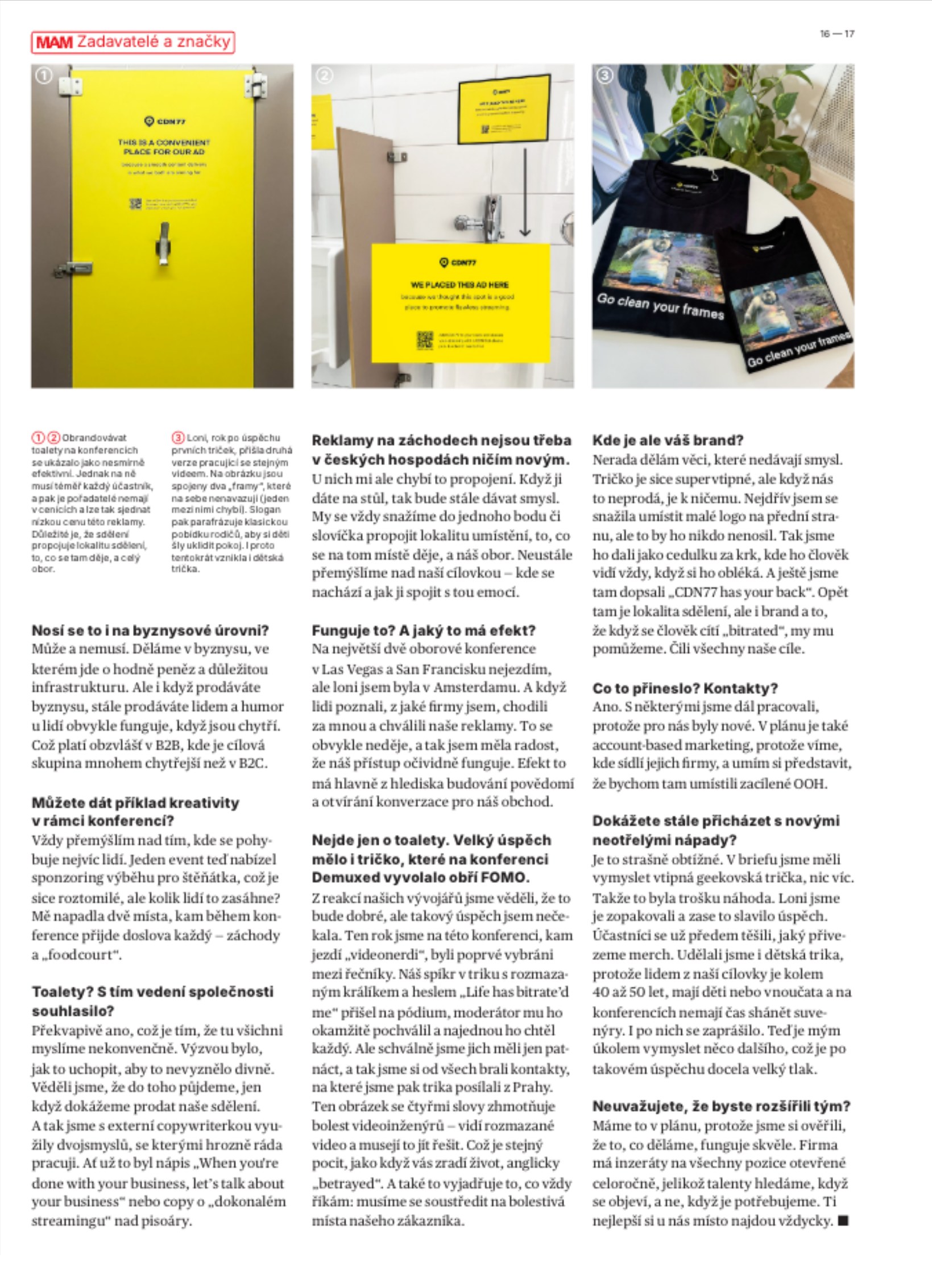
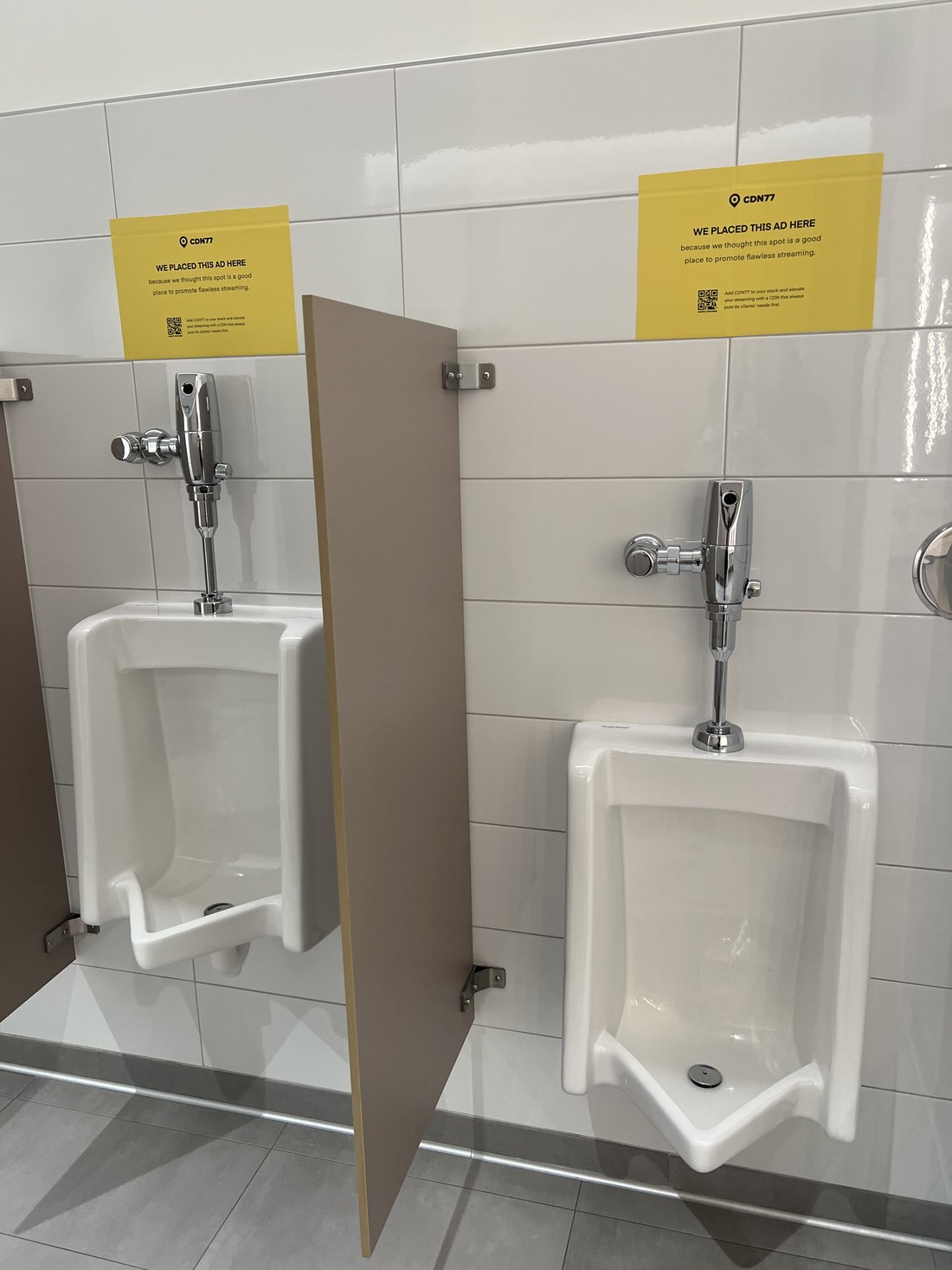
Surprisingly yes, which is because we all think unconventionally here. The challenge was doing it without sounding weird. We knew we would only go for it if we could sell our message. So our external copywriter and I used puns, which I love. Whether it was the sign “When you’re done with your business, let’s talk about your business” or copy about “perfect streaming” above urinals.
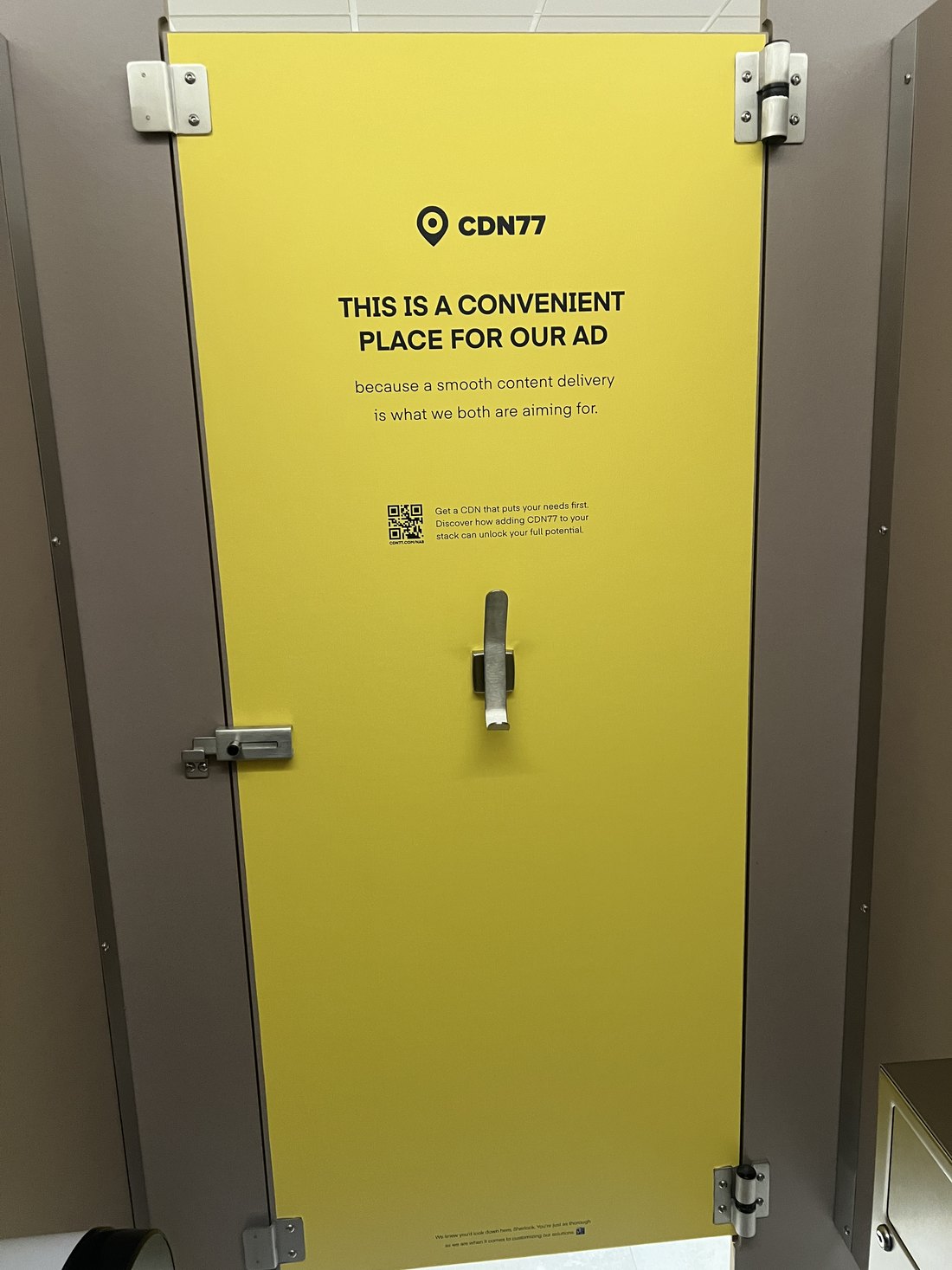
But I miss that connection with them. When you put it on the table, it still makes sense so why put it in the toilets? We always try to link location, context, and our field in a single point or word. We constantly think about our target group: where they are and how to connect our message to that moment or emotion.
I don’t go to the two biggest industry conferences in Las Vegas and San Francisco, but I went to Amsterdam last year. And when people found out what company I was from, they came up to me and praised our ads. That doesn’t usually happen, so I was happy that our approach was clearly working. It’s mainly effective in terms of building awareness and opening up conversations for our business.
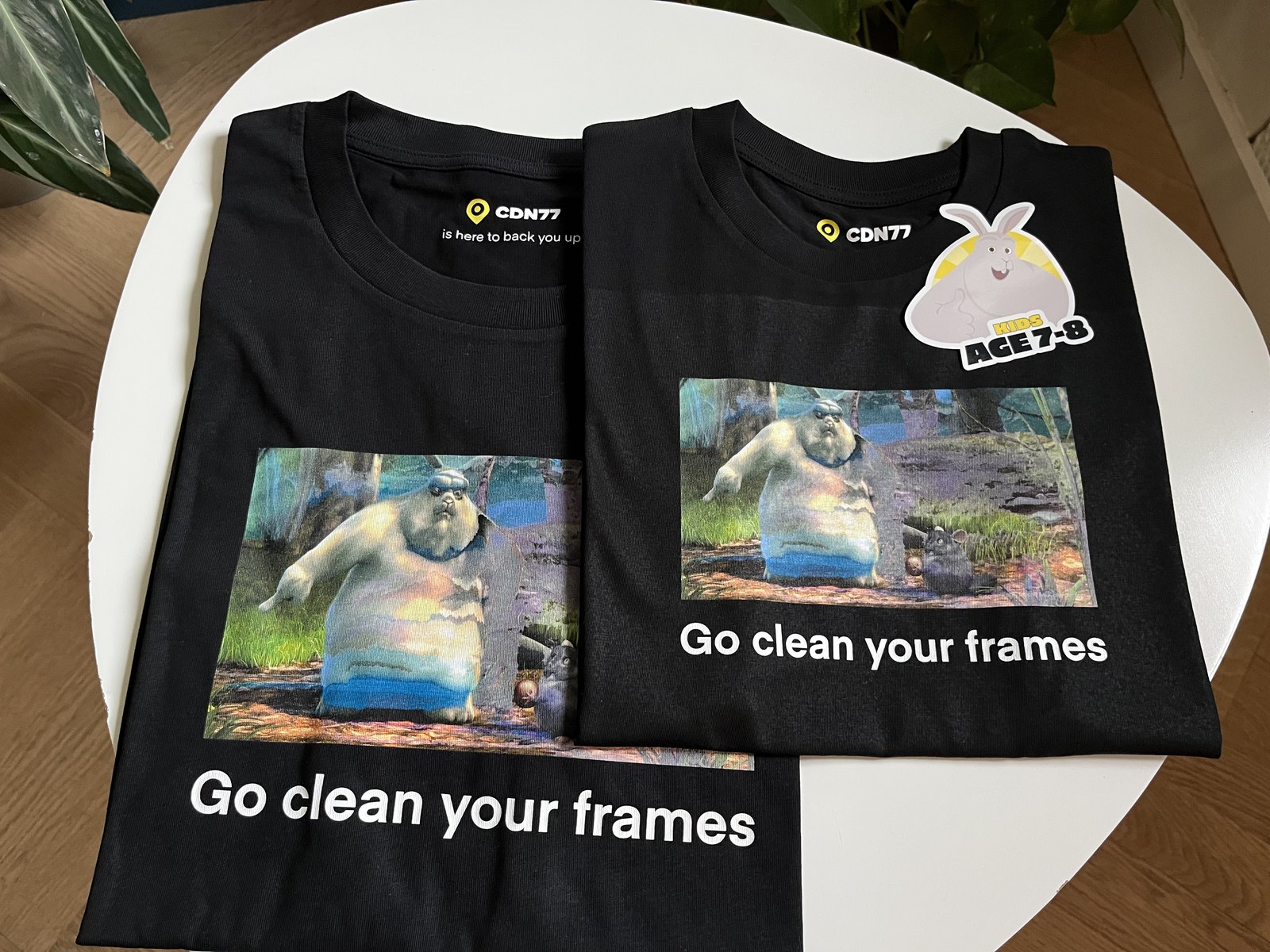
We knew from the reactions of our developers that it would be good, but I didn’t expect such a success. That year, we were chosen as speakers for the first time at this conference, where “video nerds” go. Our speaker appeared on the stage in a T-shirt with a pixelated bunny with the slogan “Life has bitrate’d me”, the moderator immediately praised him and suddenly everyone wanted the T-shirt. But we only had fifteen of them on purpose, so we took contacts from everyone, and then we sent the T-shirts to them from Prague. That picture with four words embodies the pain of video engineers: they see a blurry video (caused by low bitrates) and have to go and fix it. Which is the same feeling as when life betrays you. And it also expresses what I always say: we have to focus on our customer’s pain points.
I don’t like doing things that don’t make sense. The T-shirt is super funny, but if it doesn’t promote us, it’s useless. At first, I tried a small logo on the front, but no one would wear it. So we put it where the tag usually is around the neck, visible every time you put it on. We added “CDN77 has your back”. Again, the message matches the placement, the brand, and it communicates that if someone feels “bitrate’d,” we’re there to help. In other words, it hits all our goals.
Yes. We worked with some of them because they were new to us. We also plan to do account-based marketing because we know where their companies are based, and I can imagine placing a targeted OOH there.
It’s really tough. The original brief just asked for funny, geeky T-shirts, so the success was partly a happy accident. We repeated them last year and it was a success again. The participants were already looking forward to what kind of merch we would bring. We also made T-shirts for kids, since the people in our target group are around 40 to 50 years old, have children or grandchildren and don’t have time to hunt for souvenirs at conferences. Even those were gone immediately. Now my challenge is to come up with something new, which is quite a lot of pressure after such a success.
We plan to grow the team because we have proven that what we do works. The company keeps all positions open year-round, so we can recruit talent as it appears, not when we need it. The best people always find a place with us.
Interview by Petr Žaloudek, photos by Daniel Hromada.
Originally published in Marketing & Media.
English translation made with the help of AI and reviewed by Hana Tran Phuong Tra.
 Phuong Tra Tran (Hana)